
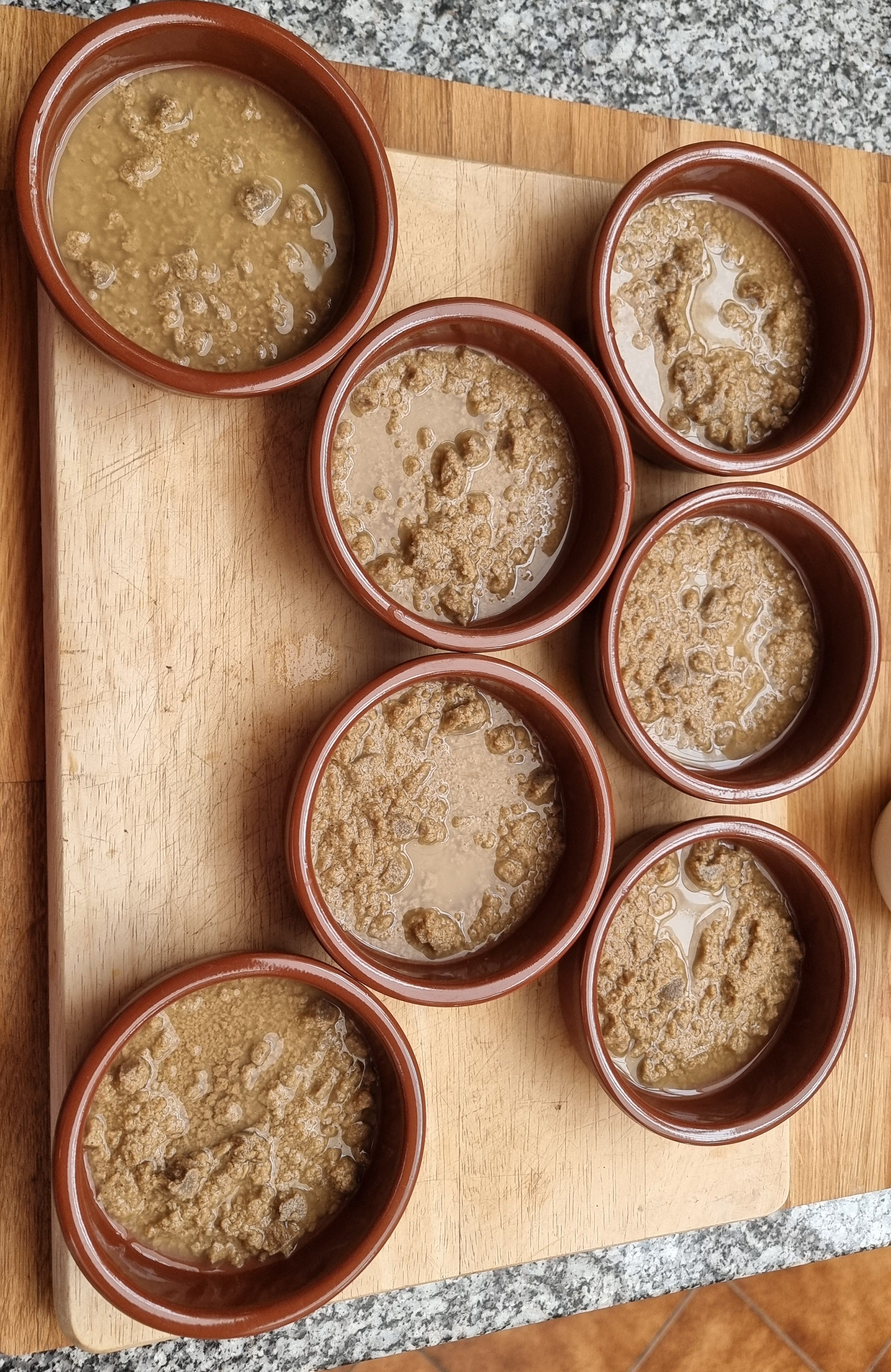
One morning I found myself looking at seven bowls lined up on a wooden board.
The puppies weren’t there yet.
Only the bowls.
At first glance, it looked like preparation. Breakfast waiting to be served. Nothing more. But standing there, I realized that by the time the bowls were ready, every important decision had already been made.
How much food.
Which food.
Who needed more.
Who needed less.
Who was growing fastest.
Who had eaten particularly well the day before.
Who hadn’t.
None of those decisions felt remarkable.
I’ve made versions of them countless times.
That may be exactly why they interested me.
The feeding hadn’t started.
Yet the outcome was already taking shape.
Long before the first puppy arrived.
Long before anyone could see the result.
I kept looking at the bowls. Not because they were different. Because they weren’t identical. The differences weren’t random. Each reflected a judgment about what mattered. What should count. And what shouldn’t.
What would have happened if every bowl had been filled with exactly the same amount?
It would certainly have been simpler.
Perhaps it would even have looked fairer.
But the puppies were not identical.
So why should the bowls be?
That question stayed with me.
Over the past weeks, I have found myself returning to similar questions from different directions.
A pattern.
A position.
A photograph.
A staircase.
A structure.
Different observations.
Yet they seemed to circle around the same underlying questions.
How do we decide what deserves attention?
How do we decide what matters?
How do we decide what counts?
The difficult part is rarely the calculation.
The difficult part is deciding what should count.
Once that decision has been made, the numbers often feel straightforward.
The calculation comes afterwards.
The ratio comes afterwards.
The explanation comes afterwards.
But the most important choice has already happened.
Long before the spreadsheet.
Long before the policy.
Long before the discussion about whether an outcome is fair.
Perhaps that is why some disagreements feel impossible to resolve.
People debate the result. The process. The rules. The numbers.
Much less often do they discuss the assumptions that existed before all of them. The assumptions that determined what would count in the first place.
I’ve noticed something similar whenever fairness enters a conversation.
The discussion often begins with measurement.
Percentages.
Differences.
Ratios.
Benchmarks.
Important things.
But they all arrive later.
They make a decision visible.
They do not make the decision itself.
Numbers matter.
Rules matter.
Structures matter.
Interpretations matter.
But none of them answer the question on their own.
They reveal what we decided should count.
And those decisions often happen long before anyone sees the result.
Long before the discussion.
Long before the numbers.
I suppose that is what kept drawing me back to those bowls.
The puppies hadn’t arrived yet.
Still, the outcome was already taking shape.
The calculation comes after the decision.
Perhaps fairness does too.
Nice 👍