
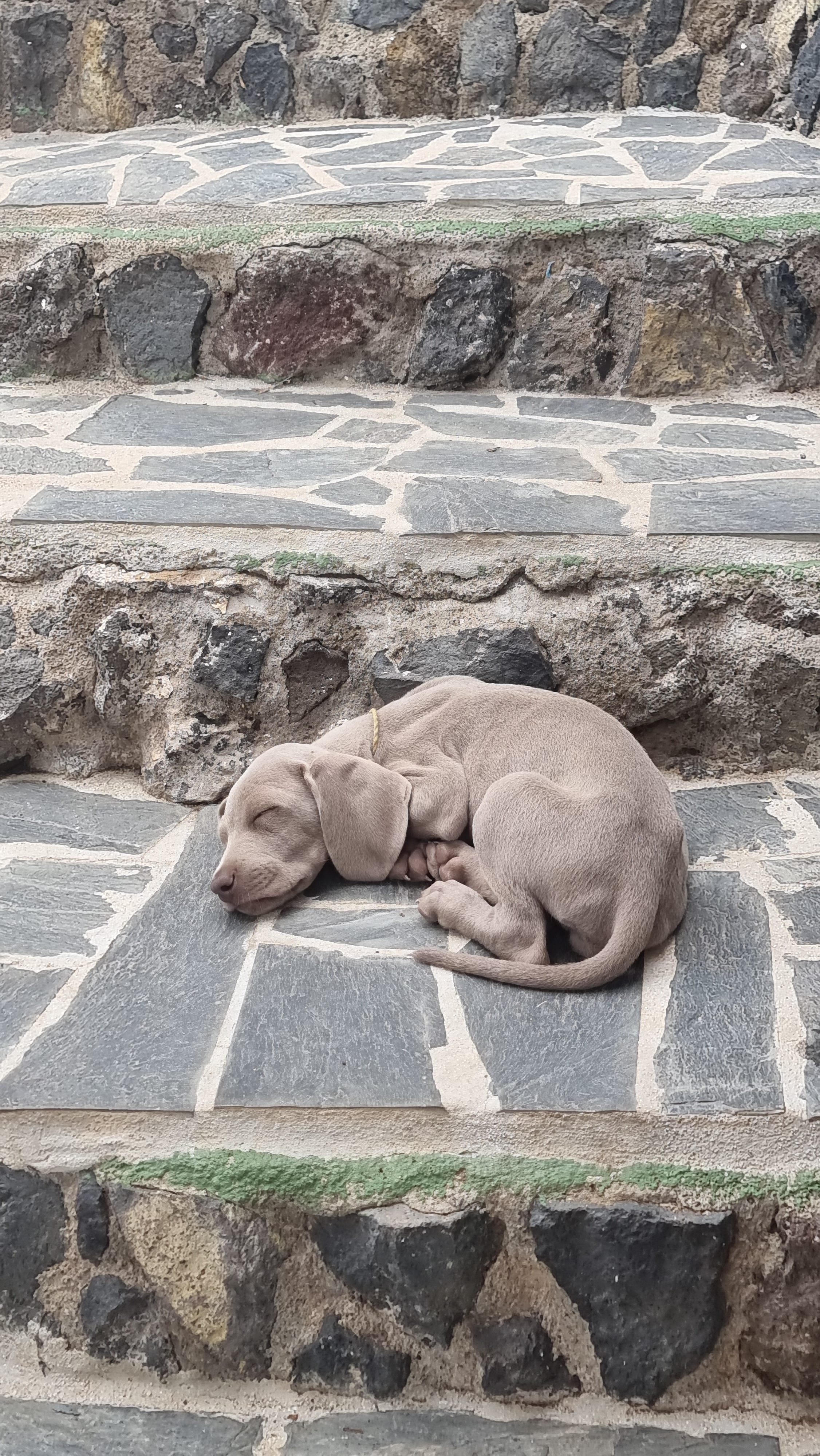
A few weeks ago, one of our Weimaraner puppies fell asleep on a staircase.
She was not at the top, and not at the bottom, but on one of the lower steps, curled into herself as if that particular piece of stone had simply become the right place to be.
Above her were several more levels. Below her, only one.
It is a staircase I know well. Stone steps built into a hillside, uneven in places, familiar from daily use. I go over those steps several times a day, up and down, usually without paying much attention to them.
That evening, I stopped.
At first, because of the puppy.
Then because of the staircase around her.
There was nothing dramatic about the scene. She was sleeping. The stones were where they always are. The light was ordinary, the kind that does not announce itself as special until afterwards.
Still, something about it made me take a photograph.
Only later, looking at the image again, did I realise what had stayed with me.
It was not only the puppy.
Somehow, she had made me notice the staircase.
Most of the time, we look at where people end up. We notice the title, the position, the room someone enters, the level someone reaches. We notice who becomes visible, who is recognised, who is said to have arrived.
The destination is easier to talk about because it is easier to see.
The path usually slips out of view.
Most days, staircases are simply part of getting from one place to another. They do not pull or push; they offer a sequence. One level leads to another, and another, until the whole arrangement begins to feel natural, almost inevitable, as if height had always been organised in exactly this way.
Standing there, I found myself paying less attention to where the staircase ended and more to everything in between: the step she had chosen, the ones above her, the one below, and the uneven distance from one level to the next.
Most things that shape our lives do not happen all at once. They accumulate in small moments, often too ordinary to be remembered later.
It may begin with a conversation, or a recommendation made almost in passing. An opportunity appears at exactly the right moment. Someone is given another chance. The same behaviour is interpreted differently depending on who displays it.
None of these moments feels decisive on their own.
Only later, when someone has arrived somewhere, or has not, do we start speaking as if the outcome explains itself.
But perhaps outcomes only look clear because we meet them at the end.
What happened before is usually less visible.
That may be why I have become less interested in ceilings.
A ceiling describes a moment.
A staircase describes a sequence.
The ceiling only becomes visible when someone eventually reaches it. The staircase has been shaping the journey long before that moment arrives.
By the next morning, the puppy had moved on.
The staircase was still there.