
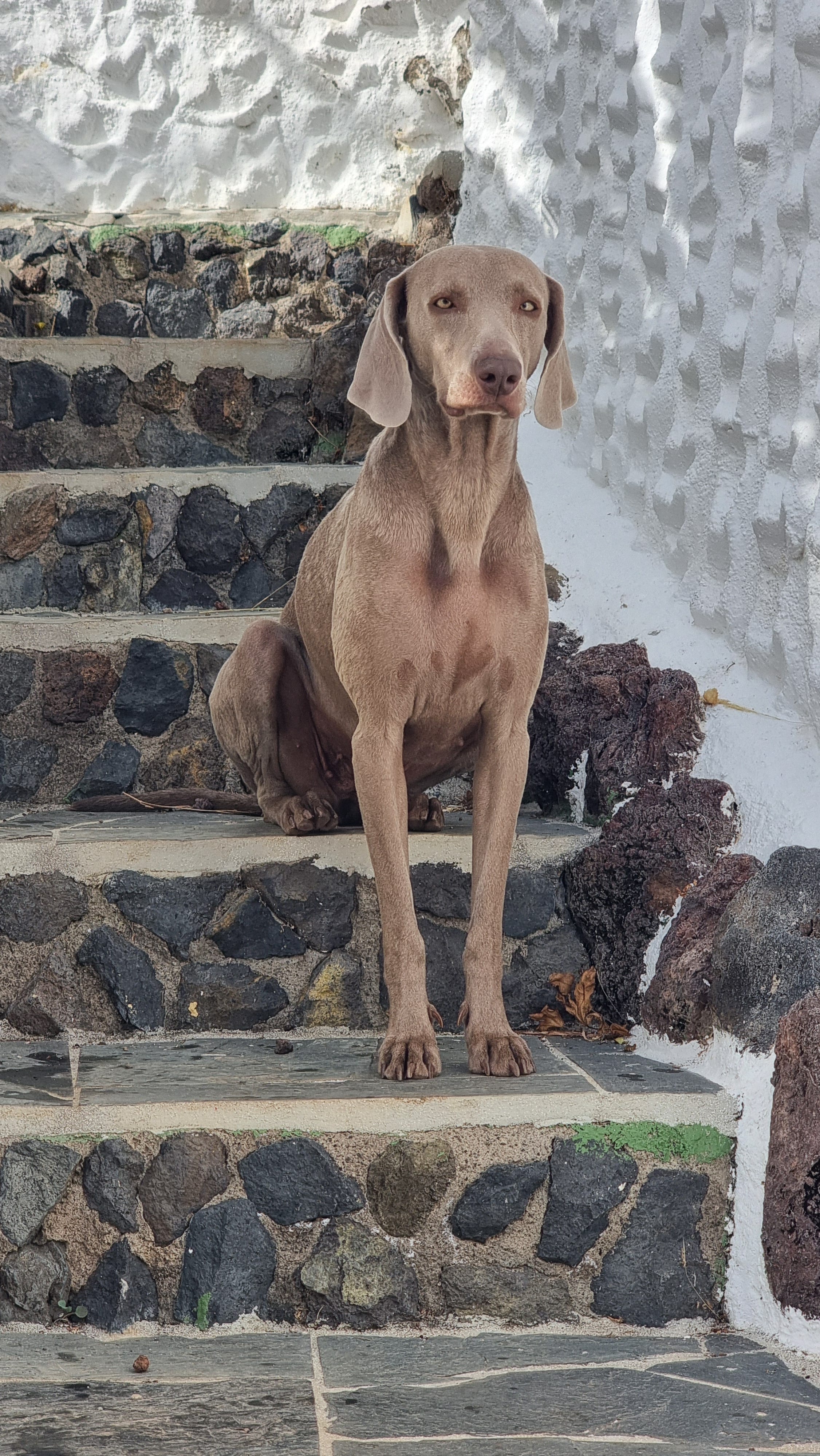
Most of the time, I take a photograph first.
The thought comes later.
This time it happened the other way around.
Diva had been sitting on the staircase for quite a while.
Not doing anything unusual.
Just sitting there.
And yet I found myself looking at her longer than expected.
There was something about the scene that held my attention.
Not just Diva.
Not just the staircase.
The combination of both.
The steps seemed to emphasize something that was already there.
Her posture.
Her elegance.
The quiet certainty with which she occupied the space.
She wasn’t at the top.
She wasn’t at the bottom.
Yet somehow the position seemed to suit her completely.
That was the moment I reached for my phone.
It wasn’t the scene I was trying to keep. It was a thought that had formed while I was standing there.
I’ve seen Diva sitting in many places. In the garden. On a path. On the terrace. She always looks like herself. But this felt different.
The staircase did not change her character.
It did not change her presence.
It changed the context in which those qualities became visible.
That distinction stayed with me.
I’ve often heard discussions framed as a choice between people and systems. As though one must explain the other. Either the person. Or the structure. Either character. Or opportunity. But standing there, looking at Diva on the stairs, that didn’t feel right.
A different dog might have created a different impression. The same dog in a different place probably would have, too. Some combinations simply fit so naturally, that we stop noticing the interaction between them. After a while, what we are looking at begins to feel inevitable. As though the position explains the individual. Or the individual explains the position.
But the staircase was not irrelevant.
It shaped what I saw.
Not by changing Diva.
But by influencing what became visible.
Perhaps structures often work in a similar way.
They do not create every quality we notice.
But they influence which qualities stand out.
Which ones attract attention.
And which remain quietly in the background.
Over time, the resulting patterns can begin to feel completely natural.
As though they emerged entirely from the individuals involved.
As though the structure had little to do with them.
Yet the staircase was there from the beginning.
Long before I noticed it.
Long before I took the photograph.
Long before I started wondering why the scene felt different.
When certain patterns keep appearing, we usually look at the people. Perhaps the more interesting question is not only who occupies a particular position. Perhaps it is also what the position allows us to see.